


What is an academic CV?
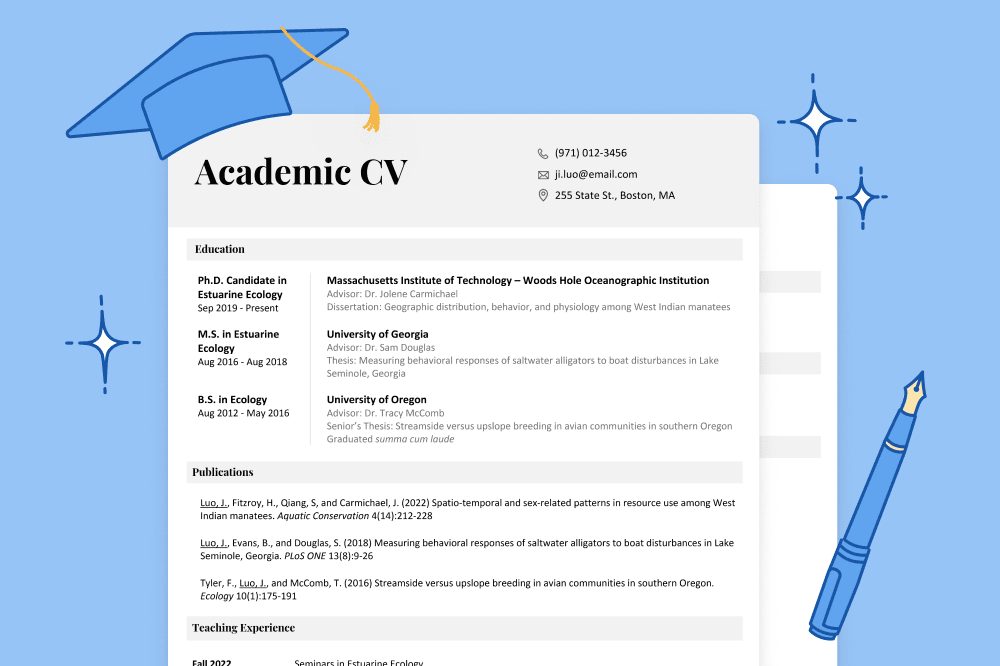
An academic CV (or curriculum vitae, which means “course of life” in Latin) highlights your whole academic career, including publications, grants, and fellowships, among other things.
Unlike a resume, which fits on 1-2 pages and is used to apply for non-academic roles, an academic CV is a comprehensive document that grows with you in your academic career – and has no length limit. A CV frequently includes the following information:
- Contact information
- Personal profile
- Education history
- Professional appointments
- Teaching experience
- Publications
- Grants & fellowships
- Awards & honors
- Invited talks
- Conferences
- Research experience
- References
- Languages
- Professional memberships
- Professional service
Learn more about the differences between a CV and a resume.

What to include in a CV
Knowing where to begin to create a CV is one of the hardest parts, but we’ll break it down section by section. To get started writing your academic CV, fill out as many of these sections as are relevant to you:
Our CV builder can make you a CV in as little as 5 minutes. Just pick the template you want, and our software will format everything for you.
1. Contact information
Your contact information should be the first thing any department head sees on your CV.
Include the following basic information:
- Name
- Phone number
- Address
While optional, it’s also common for academics to include other contact information, such as your:
- Google Scholar Profile, ORCID, and/or NCBI Bibliography
- Professional website or Github
2. Personal profile
If you’re applying for research internships or scholarships while still an undergraduate, use the personal profile section at the top of your CV to briefly explain who you are, why you want to advance your study in that specific area, and summarize some of your key accomplishments.
But if you already have or are in the process of getting your advanced degree, skip the personal profile. Your education, published works, and employment appointments will speak to your abilities and potential.
Additionally, your research and/or teaching statements for professorship applications (or biosketch for grant applications) will be the place to show the review committee who you are.
Not sure how long your CV should be? Academic CVs can be much longer than a standard one-page resume (and can extend into tens of pages). To help reviewers find information and keep your application materials together, include your name and page number on every page.
3. Education history
Having a detailed education section on your CV is essential for anyone in academia.
You should state your educational background in reverse chronological order, starting with the university you currently attend (or most recently graduated from). For each entry, state the institutions you’ve attended, degree earned, and your date of graduation.
If you’re writing an undergraduate CV and don’t have much experience yet, highlight achievements in your education section such as your GPA or if you made the Dean’s list.
You can also highlight relevant coursework to prove that you have solid foundational knowledge in the field.
Graduate students and post doctoral researchers should include the name of their thesis advisor and dissertation title (or area of study, if you’re still completing your thesis).
Here’s an example of a properly formatted education section for an academic CV:
Aug 20XX – Aug 20XX
Cornell SC Johnson School of Business
MBA, Dean’s List
Thesis: Supply Chain Management: Differences in Theory and Practice
Aug 20XX – May 20XX
West Chester University of Pennsylvania
BBA summa cum laude
Thesis: How do Global Politics Interfere with International Business Synchronization?
4. Professional appointments
List your professional appointments on your academic CV. Keep in mind that these are positions related to academia, not previous jobs you had as a chef or computer programmer.
Only include contractual academic-related work in your professional appointments section, and list the following information for each entry:
- Institution
- Department
- Your title
- Dates employed
- Duties
5. Teaching experience
If you’re a current or aspiring professor, this section will be one of the most important parts of your CV. List any TA positions, adjunct positions, or courses that you’ve taught here.
For each entry, include the institution, department, course, dates taught, and whether the course was graduate or undergraduate.
There is no need to list your duties as TA. The only exception to this rule is if your department/institution requires TAs to design and teach courses. If this is the case for the courses you taught, then list duties on your CV.
Note that if you’ve held many TA/adjunct positions, you should highlight only a few that are relevant to the program, position, or field you’re applying for.
6. Publications
Have you conducted and published research? Your publications are possibly even more important than which universities you’ve attended or your professional appointments. This is especially true if you’re already an established expert in your field.
Research contributions and publications are often the cornerstone of an academic CV, especially for positions that are research-intensive. In many disciplines, a strong publication record is a clear indicator of an individual’s ability to conduct independent research, collaborate, and contribute to the field. However, it’s crucial to note that the significance of these contributions varies depending on the nature of the academic role, the department, and the institution.
Dr. Andrew Stapleton of Academia Insider
When listing your publications, you should:
- Divide your publications into “peer-reviewed” and “other”, and then organize them by publication date.
- Divide them based on where they were published, whether that’s peer-reviewed journals, books, book chapters, book reviews, edited volumes, or web-based publications.
- Provide the full citation or as much information as you currently have. If they are currently in the process of being published they should be categorized as “in press” instead of the year published.
- Bold or underline your name for each of your publications to emphasize what you’ve done.
- Add an addendum before listing your publications if your field orders authors alphabetically.
Make sure to cite your publications correctly, using your target institution’s preferred citation format consistently throughout your academic CV.
Here’s an example of a properly formatted publications section on an academic CV:
Single-Authored Books
- Mode, E. (2021) Identity Crisis: A Psychology of 21st Century Asian American Immigrants. Cambridge and New York: Cambridge University Press.
Edited Books
- Mode E., and Parr, R. (2021) Case Studies in Dialetic Behavior Therapy for Anger Management. University of California Press.
Articles
- Mode, E., Violet, D., Dash, R., and Xu, K., (2022) Art therapy and its predictive power in depressive and anxiety symptom improvement. Behaviour Research and Therapy, 80, 212-220.
- Mode, E., Frozone, L., and Helen, E. (2020) The effectiveness of CBT interventions on psychological and academic outcomes in adopted children. Clinical Child Psychology and Psychiatry, 21, 48-60.
7. Grants & fellowships
In general, getting funded means that other agencies believe in the potential and worth of your research — and view you to be uniquely equipped to perform future research. So, providing evidence of your grants is a great way to illustrate your accomplishments to department heads.
When listing grants or fellowships on your CV, simply list which institution provided the funding, along with the year span.
Providing the monetary value of the grant is field-specific, so check first before you include it.
8. Awards & honors
If you’ve received any awards, mention them here. First list the date you received it, granting institution, and the award name (or some sort of description).
Listing the monetary value of the award is field-specific. Check with a trusted official/senior advisor in your field.
9. Invited talks
If you’ve been invited to speak at conferences or other universities, you should list that in an independent section. Include the institution’s name and location, department, dates of the talk, and a brief description (or simply the title) of what you spoke about. For conferences, you may also want to note the presentation type, such as a plenary or session talk.
Being invited as a speaker is a great addition to your CV because it demonstrates to department heads that you have recognition as an expert in your field of study.
10. Conferences
Have you participated in a conference before? You should include that in your academic CV as well.
Note that these are conferences in which you did not give a lecture. List these with the conference name, organizing panel/institution, and dates.
Additionally, mention the acceptance rate of the conference if you want to emphasize how prestigious the event is.
11. Research experience
If you’re writing an academic CV as an undergraduate, you will want to describe any RA (Research Assistant, Research Associate) experiences you’ve had.
When listing research experience on your academic CV, include the date, institution, and position held.
Then provide a short description, using either paragraph or bullet formatting, to explain how the research was done. Briefly, you should identify the research question and the methodologies you used (e.g., experiments, modeling, literature search).
12. References
Unlike a standard resume or a CV for a job, you should include a list of references toward the bottom of your academic CV.
List each reference’s name, title, mailing address, telephone number, and email address.
While this seems like a lot of information for one person (and it’s highly unlikely that the institution will actually contact them by mail), this is the traditional format for including references on a CV and should be followed by everyone. For example:
Brady Bender, PhD.
515 E. Jefferson Street
Ann Arborm MI 48109
(734) 123-4567
bradybender@uom.edu
John Willborow, Ph.D.
1 Lomb Memorial Drive
Rochester, NY 14623
(212) 012-3456
Charles Robinson, Ph.D.
1677 Schultz Street
Knoxville, TN 37996
(865) 987-6543
c.robinson@uot.edu
13. Other optional sections
You may add extra sections to give review committees a full picture of you. Such sections may include:
- languages (along with your proficiency level in reading, writing, and speaking for each)
- professional memberships
- professional service (e.g., students you’ve mentored, journals or funding bodies you review for, public outreach you’ve done)
Academic CV examples
Not sure what your CV should look like? Here are two academic CV examples that illustrate how you should format your CV and what information you need to include:
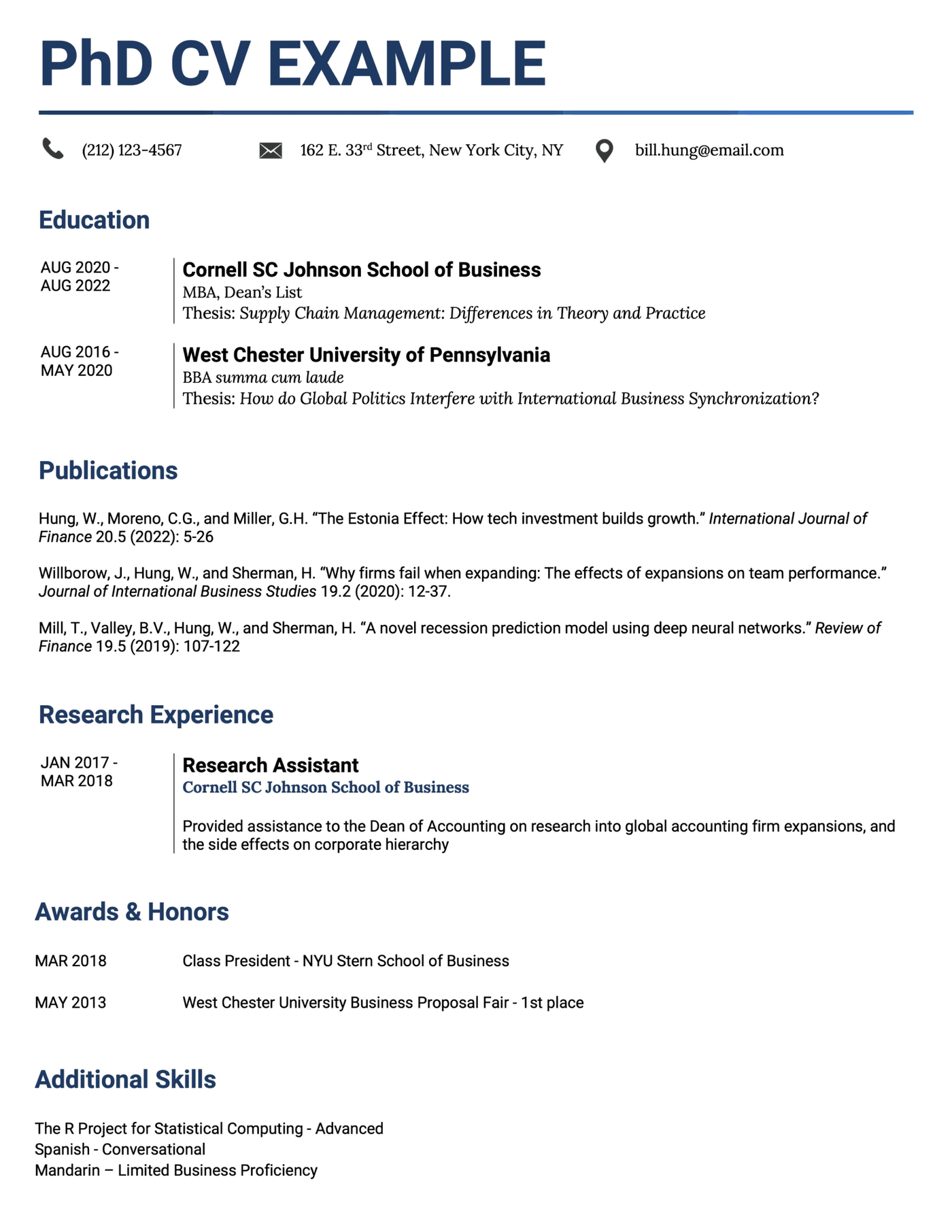
PhD CV example
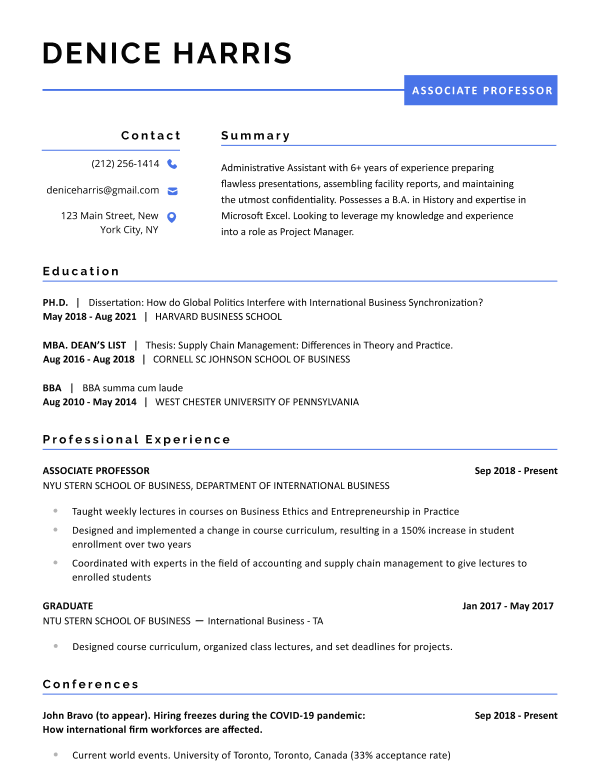
Here’s an example of the first page of a successful academic CV written by a recent MBA graduate applying for a PhD program.
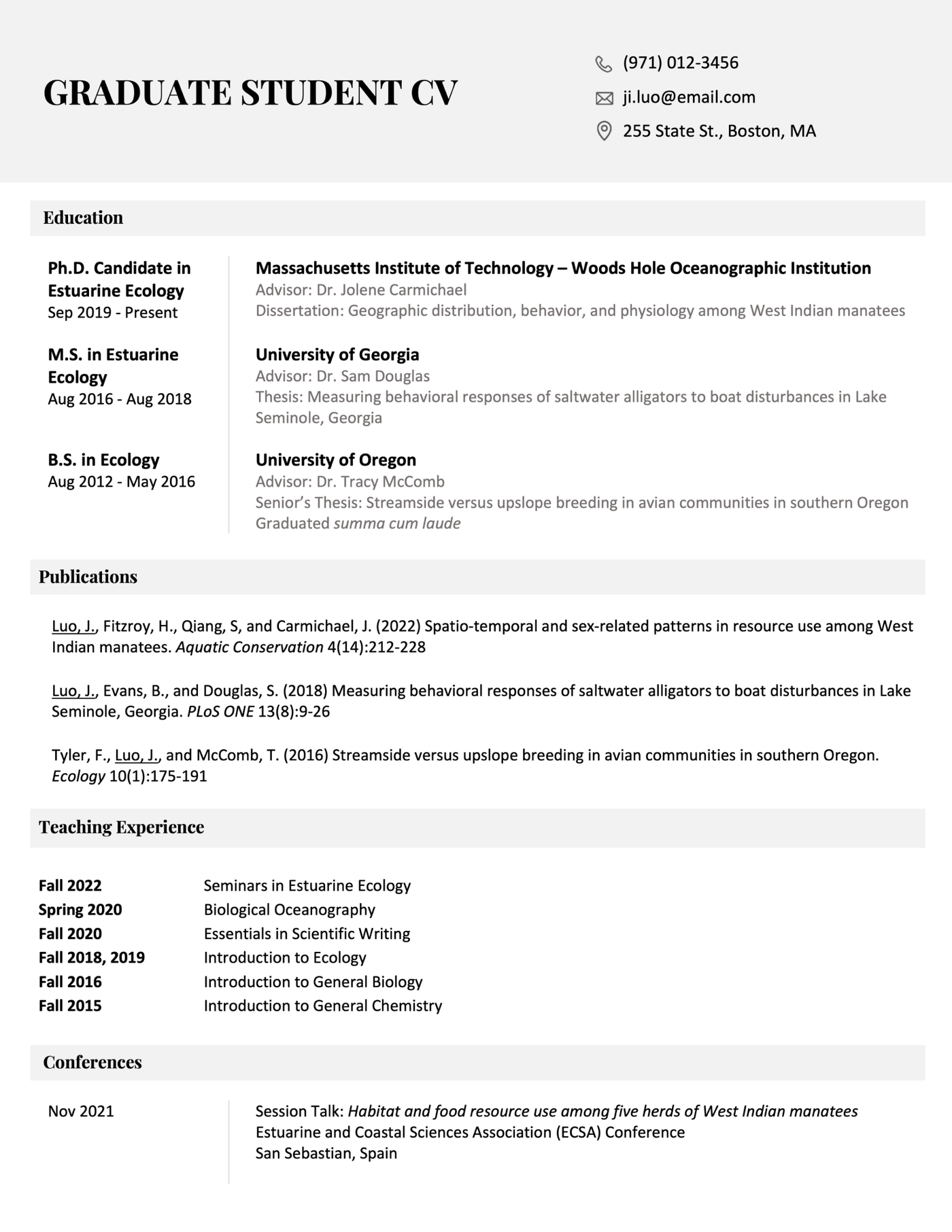
Graduate student CV example
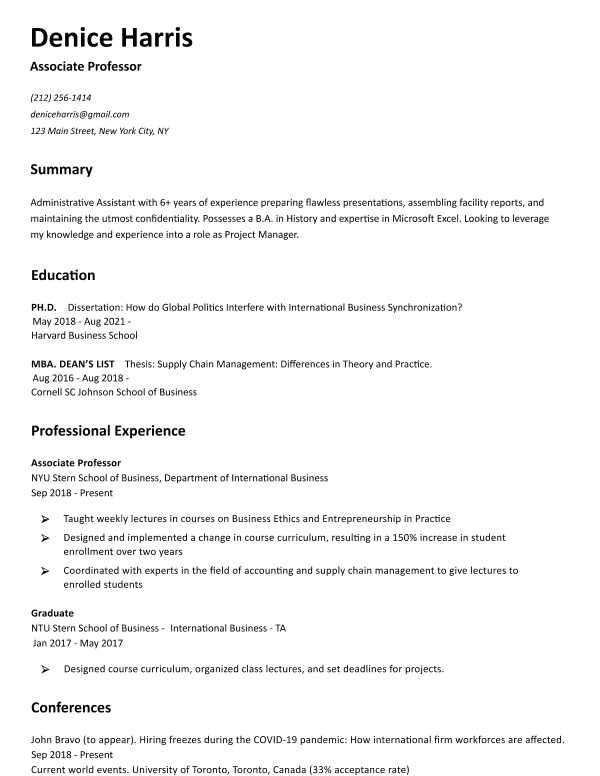
Here’s an example of the first page of a graduate student’s CV written in an application for a grant fellowship.
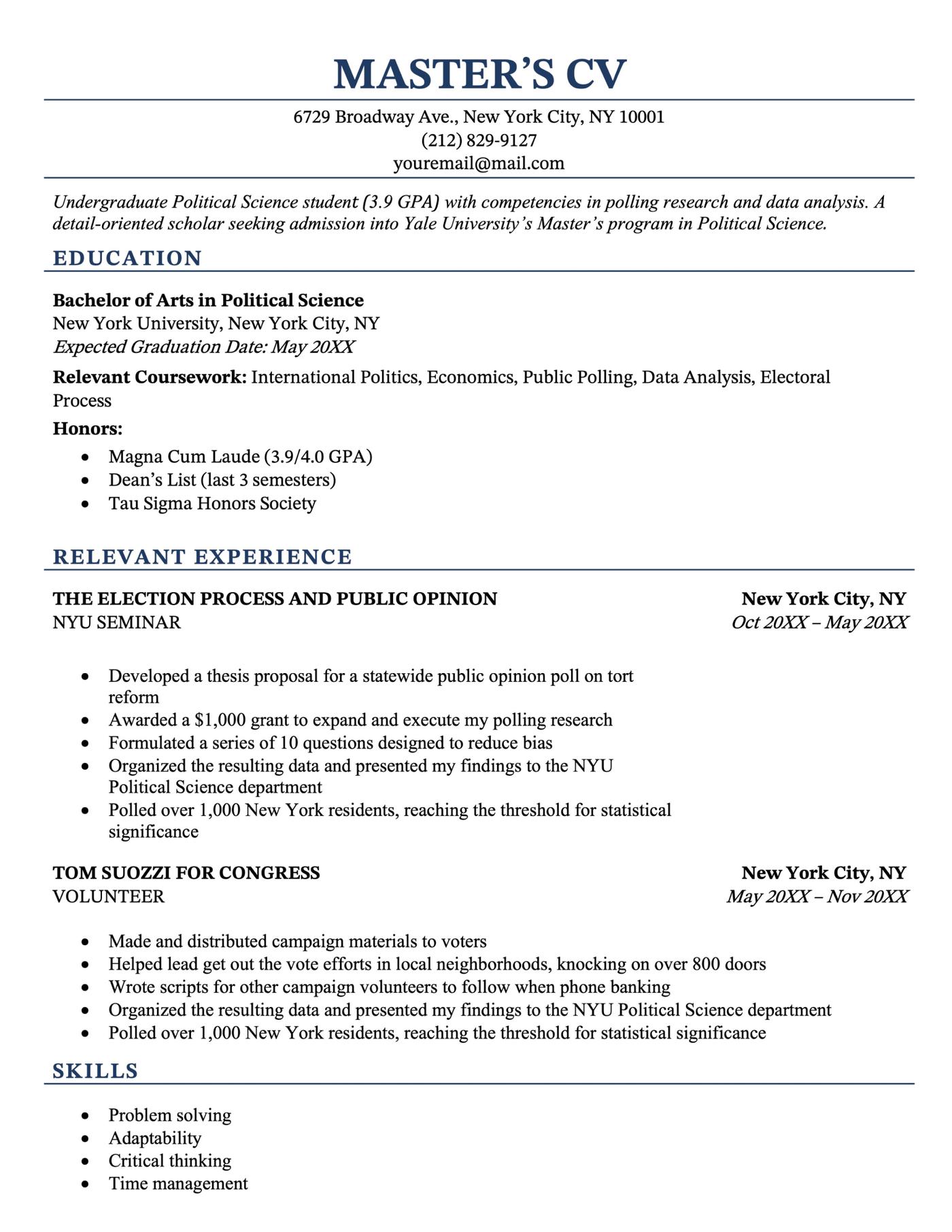
Masters CV example
If you’re writing a CV for a master’s program, use the example below for inspiration:
Academic CV template
Here’s an academic CV template that you can paste into Microsoft Word or Google Docs and fill out. It includes an outline for each section you should include, and what information you should list to best highlight your qualifications.
1. CV Heading
FIRST AND LAST NAME
Email: youremail@gmail.com | Phone: 895 555 555 | Address: 4397 Aaron Smith Drive Harrisburg, PA 17101 | Linkedin: linkedin.com/in/yourprofile
2. Personal Profile
Recent graduate from [Institution Name] with expertise in [field]. [Briefly describe any personal achievements, such as Dean’s list, previous research assistant positions held, etc]. Looking to utilize knowledge gained during my research on [research topic] to undertake postgraduate research into [future research topic, or thesis proposal].
3. Education
Dates (most recent first) | Degree Name/Major
Institution/University, Location
Relevant coursework: You can list relevant areas of study here
Honors (if applicable)
4. Professional Appointments
Dates (most recent first) | Position (i.e., Associate Professor, etc.)
Institution/University, Department
- Include a bulleted list of your duties
- Highlight any improvements or accomplishments you made
5. Teaching Experience
Dates (most recent first) | Position (i.e., TA, etc.)
Institution/University, Department
- Further divide by undergraduate and graduate courses taught
- Only include a bulleted list of duties if your institution requires TA’s to solely design and teach courses
6. Research Experience
Dates (most recent first) | Position (i.e., Research Assistant, etc.)
Institution/University
- Include a brief description of your duties. These can be bulleted or in paragraph format
7. Publications
- This section depends on which bibliography you are using
- Below is an example of MLA format
- Note that you can list multiple names, using a comma to separate each name
Last Name, First Initial. “Article.” Journal name Volume Number. Issue Number (Year Published): Pages
8. Awards & Honors
Date | Awarding Institution | Award title
9. References
- List your reference’s first and last name
- Include their address
- Phone Number
Once you’ve mastered the academic CV, find your next academic position using our list of the best job boards for higher education.
3 tips for writing an academic CV that stands out
Now that we’ve gone through the sections that you should include on your academic CV, here are three tips for writing a CV that increases your likelihood of landing your desired position.
1. Know your audience
One of the most overlooked parts of writing a CV is tailoring it for the audience that’ll be reading it. For example, you should adjust your CV to whichever department or field that you’re applying for.
What do they value above anything else? Research? Educational experience? Publications? Whichever it is, list it first on your CV so that the department head finds what they’re looking for immediately.
Additionally, do research online regarding previous applicants and their experience, or talk to experts/senior advisors within your field to find out more about what that institution is looking for in a candidate.
Understand the department’s needs: Research the department’s specialties, gaps, and future directions. Tailor your CV to highlight experiences and skills that align with these.
Emphasize fit: Instead of just listing accomplishments, make it clear how these accomplishments make you a good fit for the department’s culture, mission, and objectives.
Speak their language: Use terminology and keywords that are commonly used in publications or communications from the department you are applying to.Dr. Andrew Stapleton of Academia Insider
2. Don’t use a lot of technical jargon
Your CV should be clear, consistent, and easily understood by anyone who reads it, not just fellow academics in your field.
That’s because university admissions departments, grant reviewers, and hiring committees may not understand all the technical jargon from the field you’re familiar with when reviewing your application. Not only that, but even other academics in your field may not always be familiar with the exact methodologies you’ve used in the past.
Your publications and research will speak for itself when it comes time for department heads to read your CV. For everything else, your information should be as easy to read and understand as possible.
3. Use a simple layout and formatting
Academic CVs can be lengthy, so having a clear, easy-to-read structure is crucial. Otherwise, committee members might overlook key information because it isn’t emphasized enough.
Avoid complicated template designs, excessive use of bold or italics, and distracting colors. Additionally, stick to a consistent font style and size throughout the document, and use clear headings for each section.
Using bullet points throughout your CV can help break up information as well, and leaving some white space on the page will make the text stand out more.
Additional resources for writing your CV
Check out these extra resources for more help creating an effective academic CV:
- Online CV Maker
- Curriculum Vitae (CV) Format (Examples & Guide)
- How to Write a CV (Curriculum Vitae)
- CV Examples for Students (With Fill-In Template)
- 400+ CV Examples for Everyone (Academic & Non-academic)
- 33 Professional CV Templates
- CV vs Resume: What’s the Difference?
- How Long Should a CV Be? Proper Curriculum Vitae Page Length
Frequently asked questions about academic CVs
Still have questions about academic CVs? Take a look at our answers to some of the most common questions below.
What is the difference between academic CV and normal CV?
In the US, “CV” always refers to an academic CV. However, outside of the US, the terms “CV” and “resume” are often used interchangeably. A “normal” CV (or resume) is much shorter than an academic resume (one or two pages), and consists of just five main sections:
- Contact information
- Resume summary
- Experience
- Education
- Skills
How long should an academic CV be?
There is no length limit for an academic CV, and how long your CV should be will depend on your level of experience. Because it should include every detail of your academic history, it’s fine for your CV to start out as several pages and continue growing from there as you gain more experience. It’s common for experienced academics to have CVs over ten pages long.
What are the most important sections to include in an academic CV?
The most important sections depend on what kind of role you’re applying for.
For example, if you’re applying for a teaching job, you should highlight your teaching experience and professional appointments. If you’re applying for roles in research, you’ll want to highlight your research experience, publications, grants, and presentations.
What are some common mistakes to avoid when writing an academic CV?
When you’re writing a CV, avoid these mistakes:
- Writing too much. Even though there’s no length limit on an academic CV, you should still aim to be as concise as possible.
- Inconsistent formatting. There are a lot of sections that go into an academic CV and it’s easier to miss formatting issues. Make sure you take the time to double check that your formatting is consistent throughout.
- Using overly-flashy templates. Keep your academic CV simple and easy to read by avoiding unnecessary design features, pictures, and graphs.
- Not tailoring the CV. You’re much more likely to get noticed if you spend some time tailoring your CV to each role you’re applying for, because it helps communicate how your qualifications make you a fit.
- Not quantifying accomplishments. It’s easy to jot down a list of duties, but it takes more thought to add metrics that help quantify your impact. Adding those results will ensure you make the strongest first impression possible.
Click to rate this article
4.4 Average rating









Facebook
Twitter
Linkedin
Pinterest
Reddit
Copy link