




- Hard Skills for Your Resume (Guide and Examples)
No matter what industry you’re applying to, you’ll need to demonstrate that you have the right hard skills to capture a hiring manager’s attention.
In fact, survey results show that 88% of hiring managers are likely to look for hard skills when scanning resumes.

What are hard skills? (& are they the same as technical skills?)

Hard skills are the specific, teachable abilities you need to perform a job. They’re usually measurable and learned through training, education, or on-the-job experience. Think of things like data analysis, copywriting, accounting, or proficiency in software like Excel or Photoshop.
You’ll often hear hard skills and technical skills used interchangeably, and in most cases, there’s no major difference. All technical skills are hard skills, but not all hard skills are strictly technical.
Examples of hard skills that aren't technical skills
- Language skills
- Typing speed
- Knowledge of grammar rules
- Writing
- Editing
- Project management
- Budgeting
- Bookkeeping
Why hard skills are more valuable on a resume than soft skills

While both hard and soft skills matter in the workplace, you should include more hard skills on your resume. Why? Because employers want to see evidence that you can perform the concrete tasks the role requires.
A resume that clearly demonstrates your ability to use tools, software, or techniques signals that you’re already equipped to do the job.
Soft skills, like communication or teamwork, are harder to measure and often come through more naturally during the interview stage, when hiring managers can observe how you interact, collaborate, or lead. But your resume is the first filter, and hard skills are what help you pass it.
You can feature hard skills in your skills section, work experience bullet points, or even in your resume summary. We’ll break down how to highlight them effectively below.
Useful hard skills (for most jobs)

Some hard skills are also transferable skills, or skills you can carry from one role or industry to another. If you’re transitioning careers or have experience in another industry, focus on these foundational skills on your resume:
Microsoft Office Suite (especially Excel)
While basic computer literacy is important to many jobs, just writing “computer skills” on your resume risks making you sound computer illiterate. Mentioning your knowledge of specific programs or software is the best alternative, and Microsoft Office programs are the most widely used computer programs. Think of listing this as saying, “yes, I’m comfortable operating a computer.”
Microsoft Excel gets a special mention because it requires higher technical expertise to use. List it if you’re comfortable using it and it’s relevant to the job you’re targeting.
Google Workspace
Put this on your resume if you’re more familiar working with Google Workspace. If you’re equally familiar with both, check whether the job description specifies Microsoft or Google Office tools and put the one the employer prefers.
Collaboration tools (e.g., Slack, Trello, Asana, Jira)
The ability to use collaboration tools is essential in modern workplaces, where projects often involve cross-functional teams and remote or hybrid setups. Platforms like Slack, Trello, Asana, and Jira streamline communication, task management, and project tracking, making sure that everyone stays aligned and deadlines are met.
Adding specific collaboration tools to your resume demonstrates your ability to work efficiently and coordinate with team members regardless of location.
Writing and editing
Most jobs require writing in some form, from long-form dedicated content writers to writing reports for your supervisor. While effective communication is a soft skill, the ability to write can be considered a hard skill.
Mention technical writing, copywriting, and editing if they’re relevant to the job.
Research
Adding research experience to your resume demonstrates that you are an independent thinker capable of critical thinking and problem solving. Research also involves applying organizational skills and time management skills, two things employers value.
Courses, labwork, or thesis writing can all be added to your resume if relevant to the job.
Statistical comprehension
Basic arithmetic and a foundational understanding of statistics are valuable in a wide range of jobs, from data analysis and research to marketing and finance. Adding this skill to your resume shows that you can interpret numerical data, identify patterns, and make informed decisions based on evidence rather than guesswork.
Language skills
If the job involves B2C or B2B communication, being able to speak more than one language is a major advantage. This allows you to connect with a broader range of clients, customers, and colleagues, breaking down language barriers and fostering stronger relationships.
Listing bilingual or multilingual abilities on your resume shows employers that you can communicate effectively across cultures, a quality that’s increasingly valuable in an increasingly global economy.
Data analysis
Data analysis is in demand in many industries, from marketing and sales to healthcare and engineering, because it enables businesses to operate more strategically. Listing data analysis on your resume signals that you can transform numbers into actionable insights, helping organizations solve problems and achieve measurable results.
Project management
Adding project management to your resume shows employers that you can deliver results by keeping teams on track. Even if you’re not applying for a formal project manager position, showcasing this skill signals that you can take initiative and organize work efficiently.
Public speaking
Adding public speaking to your resume shows that you’re comfortable expressing ideas in a clear, confident way, whether you’re presenting to colleagues, clients, or larger audiences. Even in roles that aren’t communication-focused, this skill suggests you can lead discussions and contribute meaningfully in group settings.
100+ most in-demand hard skills (by industry)

When making a resume for a job or preparing for an interview, having a list of your hard skills is always a good idea. We analyzed hundreds of real job listings to find the most valuable hard skills for resumes (and work) in 2025:
IT & software
IT and software careers rely heavily on technical hard skills such as coding, system management, and data analysis. These hard skills are critical for building and maintaining digital systems:
Percentage of job ads mentioning each skill
Data
| Keyword | Count |
|---|---|
| Project planning | 52 |
| Microsoft Office | 39 |
| Cloud platforms | 34 |
| Web development | 33 |
| Databases | 30 |
| QA testing | 27 |
| Software knowledge | 25 |
| Product management | 25 |
| Version control | 24 |
| Process improvement | 18 |
Engineering
Engineering careers require mastery of specialized software, mathematical modeling, and testing procedures:
Percentage of job ads mentioning each skill
Data
| Keyword | Count |
|---|---|
| Project management | 33 |
| Engineering design | 28 |
| CAD | 25 |
| Technical support | 24 |
| System engineering | 21 |
| Mechanical engineering | 18 |
| Technical documentation | 18 |
| Process improvement | 17 |
| Quality assurance | 16 |
| Electrical engineering | 16 |
Truck & delivery driver roles
Success in truck driving and logistics depends on your ability to streamline the movement of goods and reduce operational risks. Common hard skills for this industry include:
Percentage of job ads mentioning each skill
Data
| Keyword | Count |
|---|---|
| Over-the-road (OTR) trucking | 24 |
| Equipment operation | 13 |
| Hazmat handling | 10 |
| Flatbed Trucking | 8 |
| Map reading | 7 |
| Safe driving practices | 5 |
| Commercial driving | 4 |
| GPS navigation | 4 |
| Load securement | 4 |
| Freight handling and operations | 3 |
Retail
Retail careers call for technical skills that support smooth transactions and create a positive shopping experience for customers:
Percentage of job ads mentioning each skill
Data
| Keyword | Count |
|---|---|
| Merchandising | 21 |
| Inventory management | 13 |
| Cash handling | 11 |
| Computer terminal operation | 8 |
| Computer skills | 5 |
| Visual merchandising | 5 |
| Sale management | 5 |
| Computer peripherals | 5 |
| Product knowledge | 5 |
| Point of sale (POS) system operation | 5 |
Hospitality & food service
Technical expertise in these areas helps maintain consistent service quality and customer satisfaction:
Percentage of job ads mentioning each skill
Data
| Keyword | Count |
|---|---|
| Safety and sanitation | 40 |
| Kitchen equipment operation | 20 |
| Restaurant management | 19 |
| Language proficiency | 12 |
| Point of sale (POS) system operation | 11 |
| Computer skills | 11 |
| Inventory management | 11 |
| Sales and marketing | 10 |
| Cash handling | 9 |
| Scheduling | 6 |
Administrative roles
The following skills support smooth day-to-day operations and help teams stay focused on their core objectives:
Percentage of job ads mentioning each skill
Data
| Keyword | Count |
|---|---|
| Microsoft Office | 51 |
| Word processing | 28 |
| Spreadsheet software | 28 |
| Data and document management | 26 |
| Office equipment operation | 22 |
| Project management | 22 |
| Presentation software | 21 |
| Operating systems | 20 |
| Software applications | 19 |
| Google Workspace | 19 |
Education
Proficiency in these areas helps teachers deliver more engaging and effective lessons:
Percentage of job ads mentioning each skill
Data
| Keyword | Count |
|---|---|
| Online learning platforms | 58 |
| Lesson planning | 43 |
| AI Tutor Copilot | 39 |
| Instructional strategy | 30 |
| Subject matter expertise | 15 |
| Curriculum development | 15 |
| IEP development and implementation | 13 |
| Maintaining student records | 12 |
| Computer skills | 11 |
| Data analysis | 10 |
Design
Mastery of these skills transforms creative concepts into functional, visually compelling results:
Percentage of job ads mentioning each skill
Data
| Keyword | Count |
|---|---|
| Adobe Creative Suite | 41 |
| Project management | 39 |
| CAD software | 29 |
| Microsoft Office | 22 |
| Graphic design | 22 |
| Project documentation | 19 |
| UX methodology | 16 |
| Quality assurance | 14 |
| Visual design | 13 |
| UX design | 12 |
Business administration
The following hard skills support informed decision-making, efficient resource allocation, and sustainable business growth:
Percentage of job ads mentioning each skill
Data
| Keyword | Count |
|---|---|
| Data Analysis | 58 |
| Project management | 45 |
| Business development | 38 |
| Documentation | 26 |
| Sales strategy | 22 |
| Marketing strategy | 21 |
| CRM | 20 |
| ERP | 14 |
| Agile Methodology | 13 |
| Presentation skills | 10 |
Marketing
The following are some of the most in-demand hard skills for marketing professionals today:
Percentage of job ads mentioning each skill
Data
| Keyword | Count |
|---|---|
| Marketing strategy | 51 |
| Data analysis | 28 |
| Marketing management | 28 |
| Digital marketing | 26 |
| Customer relationship management | 22 |
| Market research | 22 |
| Content marketing | 21 |
| Business development | 20 |
| Social media marketing | 19 |
| Campaign management | 19 |
How to showcase your hard skills in job applications
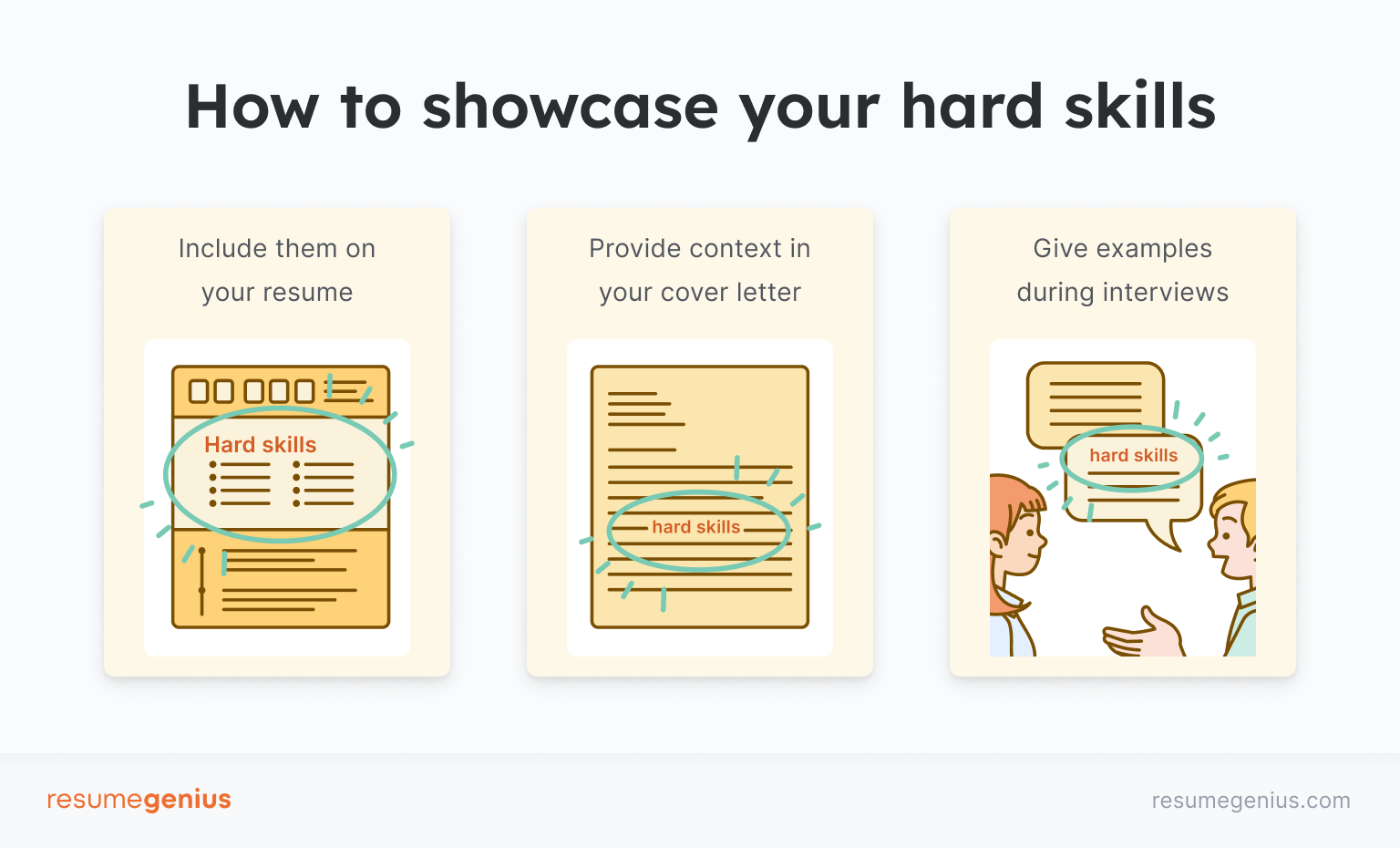
Having the right hard skills required for your target position isn’t enough. You need to prove to employers that you can use them effectively, too. Here’s how:
On your resume
The most straightforward way to highlight your hard skills is to connect them to real accomplishments on your resume.
The bullet points in your resume’s work experience section should demonstrate how you used a specific skill to accomplish measurable goals.
Here’s an example:
- Developed and deployed a sentiment analysis model using BERT and PyTorch, processing over 10,000 customer reviews daily, and integrated it into the company’s data pipeline using Apache Kafka and Docker
Additionally, include a dedicated skills section on your resume. Put your most relevant hard skills at the top of this section so employers see them right away:
- Data analysis: (Excel, SQL, Tableau, Python)
- Project management: (Agile, Scrum, Trello, Jira)
- Communication: (Public speaking, professional writing, active listening)
- Collaboration tools: (Slack, Microsoft Teams, Google Workspace)
- Marketing tools: (Google Analytics, Mailchimp, SEMrush, Canva)
- Basic coding skills: (HTML/CSS, Javascript, Git)


In your cover letter
Your cover letter is your chance to provide additional context for the hard skills listed on your resume.
Focus on the skills mentioned in the job posting, especially in the “Requirements” section.
I’m excited to submit my application for the Video Editor position at Fragment Media as advertised on LinkedIn. With over 5 years of experience creating high-quality video content, I excel at using Adobe Premiere Pro and DaVinci Resolve to deliver engaging projects on time. My expertise in motion graphics, audio mixing, and color grading will make me an excellent addition to your team.
During an interview
Interviews are another opportunity to showcase your hard skills. When answering interview questions such as “What is your greatest professional achievement?,” connect your answer to measurable results.
For example, you might say:
In my previous role as a marketing coordinator, I used Google Analytics to identify a major drop-off point in our sales funnel, redesigned the targeted ad campaign, and increased conversions by 18% within two months.
How to develop hard skills

There are many ways to develop hard skills, including:
- Signing up for a course: Whether online or in-person, a course can help you develop your hard skills. Platforms like edX, Udemy, and Coursera offer classes on everything from coding to grant writing.
- Pick up a relevant hobby: If you’re preparing to enter a new field, choose a hobby that strengthens your skills in that area. For example, if you’re aiming for a social media marketer role, try photography or video editing in your free time.
- Volunteer: Doing volunteer work is a great way to apply and improve your skill set. Look for opportunities that match your career goals.
- Take on new challenges at work: If your employer offers professional development programs, sign up. You can also volunteer for projects that require learning new tools or software.
Frequently asked questions about hard skills
Here are answers to some of the most common questions about hard skills:
Why are hard skills important?
Hard skills are important because they equip you to handle job-specific tasks that require previous experience, knowledge, or training. Employers tend to look for candidates with a balanced mix of hard skills and soft skills to ensure you can not only perform the technical aspects of your job but work well with others.
How are hard skills different from soft skills?
Hard skills are technical and job-specific, while soft skills relate to personal attributes and interpersonal abilities, like communication or team coordination.
How do employers test hard skills?
Employers often evaluate hard skills through practical assessments, technical tests, portfolio reviews, or scenario-based interview questions that require you to demonstrate your abilities in real time.
They may also use job simulations, case studies, or trial projects to see how you apply technical knowledge to real-world challenges. In some fields, formal certifications or licensing exams serve as an additional way to verify proficiency.
Click to rate this article
4.8 Average rating












Facebook
Twitter
Linkedin
Pinterest
Reddit
Copy link