




You should include both hard skills and soft skills on your resume, but only hard skills belong in the skills section. Soft skills should be demonstrated in other sections.
This video explains 5 of the best skills to have on your resume, and how to list them:

Only put hard skills in your resume skills section
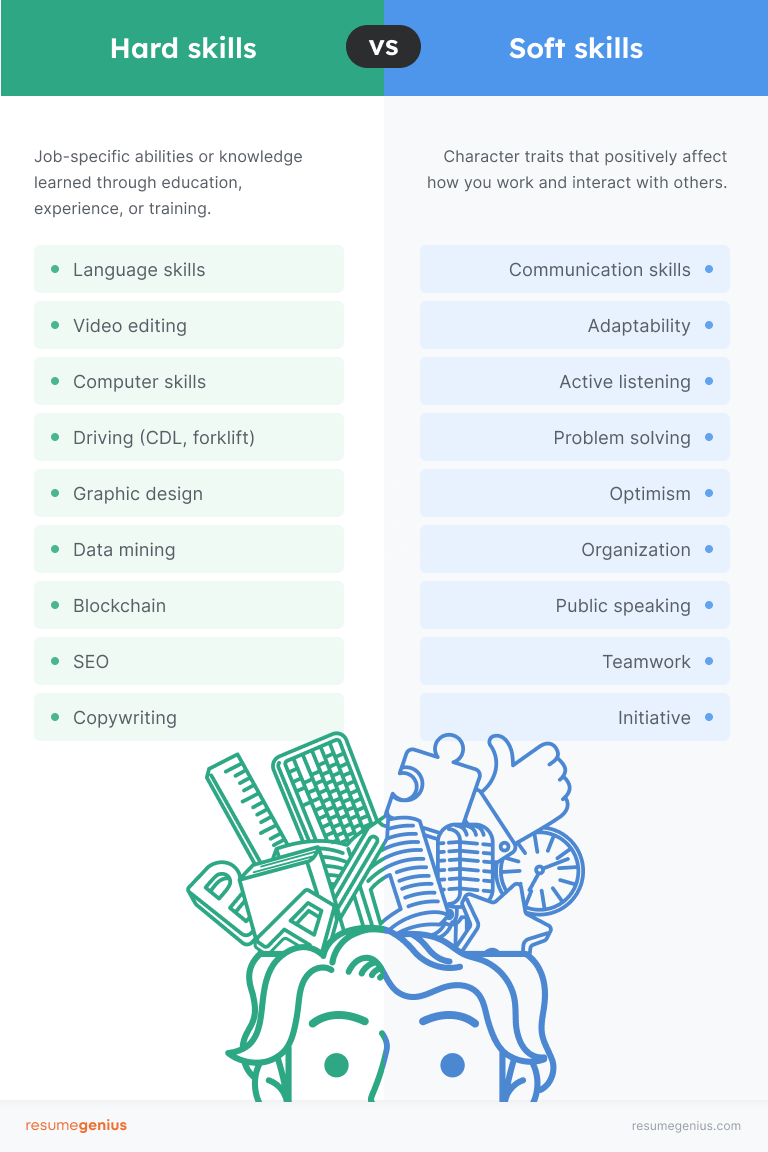
Hard skills, also known as technical skills, are job-specific abilities gained through education, training, or experience.
These skills are concrete and measurable, and you should list them in your resume’s skills section. Here’s what that looks like:
List hard skills in your skills section
SKILLS
- Proficient in POS systems
- Operations management
- Merchandising and product display strategies
- Loss prevention
Employers list the hard skills they’re looking for in job ads, so if you have those skills, you should highlight them on your resume.
You can also try using our AI skills generator to find industry-specific hard skills:
Make a high-impact skills section for your resume in seconds with our free software. Simply enter your job title and you’ll be matched with the most impactful skills for your industry.
Use these job-specific skills to make a resume that lands you interviews.
Hard skills vs. soft skills
The difference between hard skills and soft skills is: hard skills are teachable abilities that can be tested and measured in a standard way, but soft skills are personality traits that are more difficult to quantify.
For example, employers understand when you just list a hard skill like “Fluent in Spanish” or “Python” on your resume. However, soft skills like “teamwork” need to be described with context in order to be convincing.
When possible, demonstrate your abilities in standardized and measurable terms. For example, it’s better to list your proficiency with organizational tools like Notion and Jira than to just write “organizational skills” on your resume.
Demonstrate soft skills in your work experience section
Soft skills are non-technical abilities that are valuable in the workplace.
These skills generally fall into three categories:
You shouldn’t just list “organizational skills” or “communication” in your skills section, though, because putting soft skills there doesn’t show employers the results you achieved.
Instead, demonstrate how you’ve applied these skills in your work experience section through targeted bullet points.
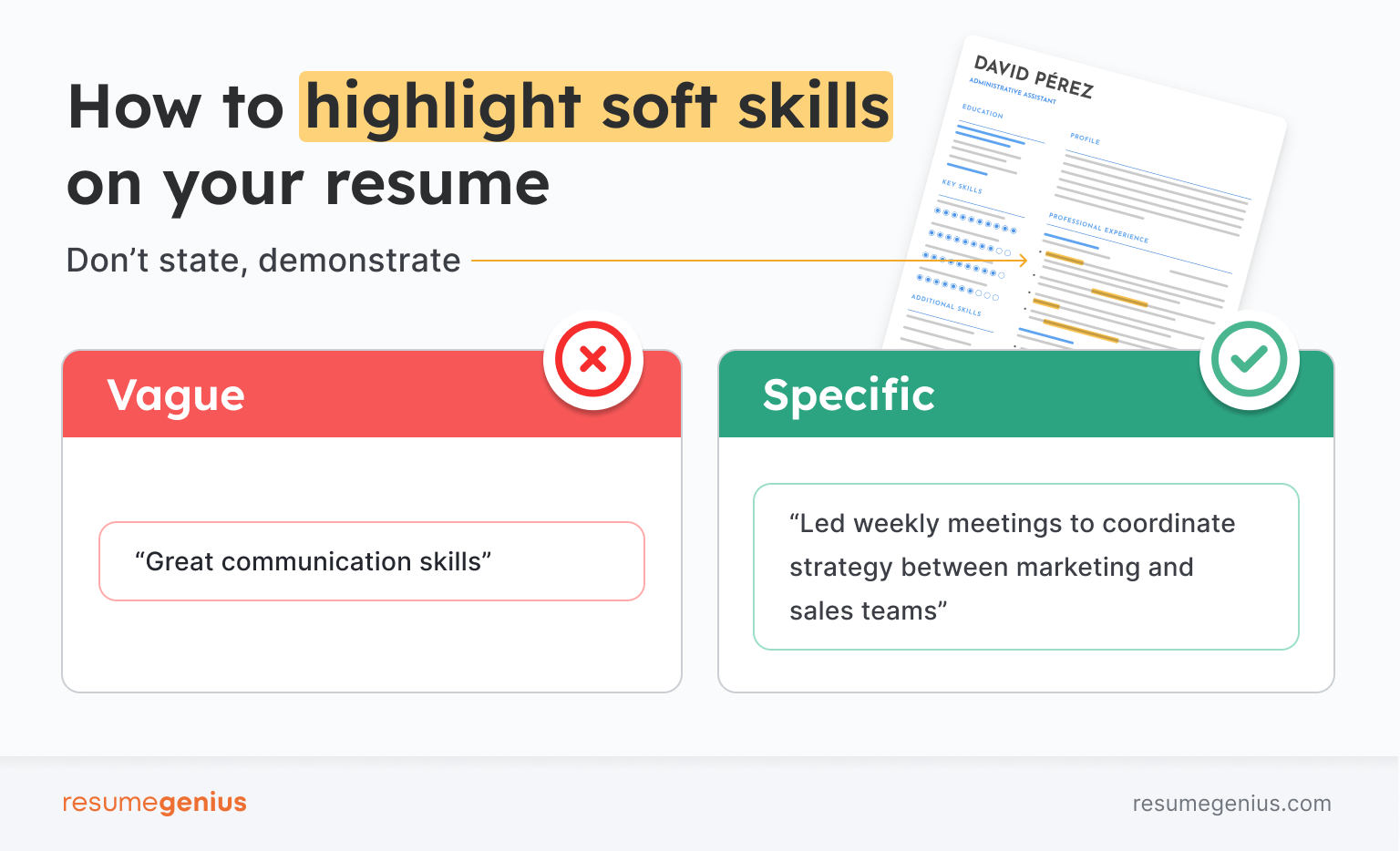
Here’s an example of what NOT to do:
Incorrect way to list soft skills on a resume
SKILLS
- Problem solving
- Communication
- Teamwork
- Time management
And here’s an example of how to list each of the soft skills above the right way — in your bullet points:
Correct way to list soft skills on a resume
WORK EXPERIENCE
- Identified issues in a workflow and suggested improvements that made daily tasks about 20% faster for a 5-person team
- Shared project updates weekly with 3 cross-functional teams to keep 15+ stakeholders aligned
- Worked closely with 6 coworkers to meet shared goals, contributing to a 10% increase in overall team output during busy seasons
- Balanced 4–6 active projects at a time by prioritizing deadlines and maintaining consistent on-time delivery
Communication skills
Communication skills include teamwork, collaboration, and interpersonal abilities. How you describe your experience should align with the specific type of communication skill the job emphasizes.
Here are three sample bullet points that demonstrate good communication skills:
Example of communication skills in a resume’s work experience bullet points
- Planned and moderated weekly team syncs across 5 departments, reducing project delays by roughly 20%
- Communicated daily with clients and teammates to clarify project goals and resolve issues efficiently
- Collaborated with customer support and engineering teams to document recurring issues, improving cross-department communication and reducing duplicate tickets by 18%
Strong communication skills are especially valuable for jobs like:
Organizational skills
Organizational skills refer to coordinating resources, tasks, and schedules. Time management, project management, and certain leadership skills are key examples of organizational skills.
Here are a few example work experience bullet points that demonstrate organizational skills:
Example of organizaitonal skills in a resume’s work experience bullet points
- Created and maintained Asana project boards to track deadlines and deliverables, helping the marketing team complete campaigns 1 week ahead of schedule on average
- Oversaw inventory across 3 office locations, maintaining accurate supply levels and reducing last-minute orders
- Managed onboarding checklists and training timelines for 10+ new hires, ensuring timely completion of setup and orientation
Strong organizational skills are vital for jobs like:
Analytical skills
Analytical skills, also known as problem solving or critical thinking, involve using logic to identify cause-and-effect relationships.
Example of analytical skills in a resume’s work experience bullet points
- Reviewed performance data to identify trends and recommend small adjustments that improved results over time
- Used reports and metrics to evaluate project success and guide next steps based on what worked best
- Analyzed customer feedback to spot patterns and help the team make more informed decisions
To demonstrate analytical thinking on your resume, provide context. Here are two ways to add that context:
- List relevant hard skills such as: proficiency in analytical software like GA4 or Tableau
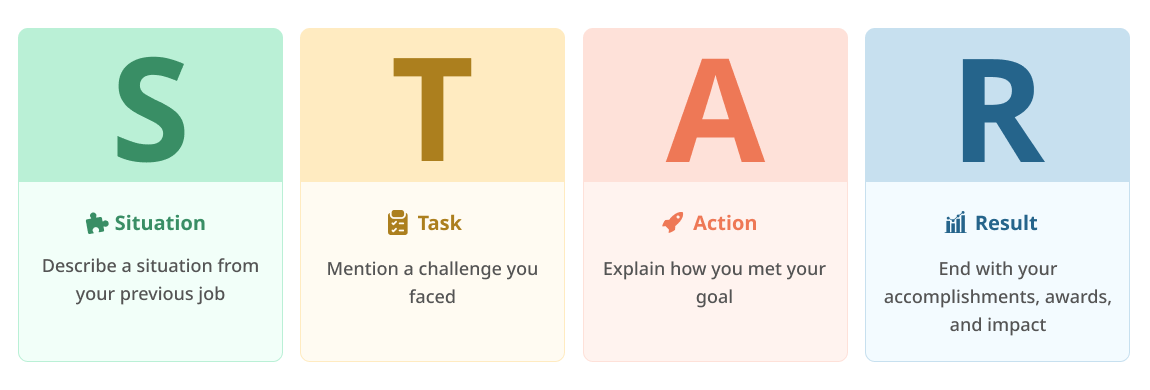
- Use the STAR method (Situation, Task, Action, Result) to write your bullet points
Strong analytical skills are important for the following professions:
Don’t forget your transferable skills
Nearly any past experience can be reframed as a transferable skill on your resume. Transferable skills are hard or soft skills that can be applied across different industries or roles.
The transferable skills you should list depend on the requirements of the job posting, so review it carefully. Common transferable skills include presentation skills, research methods, writing, and computer literacy.
Skills are just one part of a winning resume
Whether you're creating a new resume or updating an existing one, every section matters. Take out the guesswork with our AI-powered resume generator.

Click to rate this article
4.8 Average rating









Facebook
Twitter
Linkedin
Pinterest
Reddit
Copy link